403 Forbidden
ERR_WEB_NGX_403

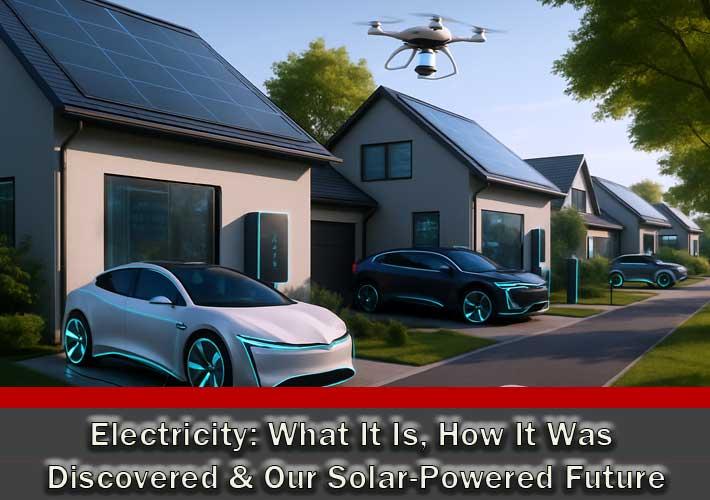
Electricity is all around us – from the lights in our homes to the phones in our pockets – yet it wasn’t always understood. This article will explain what electricity is in simple terms, explore its historical origins and discovery, and highlight key figures like Alessandro Volta and the influence of electric eels on early experiments. We’ll also use the “big kettle” analogy to demystify how our electrical systems work. Finally, we’ll look ahead to a future where humanity might rely on solar power, with homes covered in panels, battery storage, and solar farms supporting entire communities.

Electricity is essentially the movement or presence of electric charge. In practice, this usually means electrons flowing through a material (like copper wires), creating an electric current. When you flick on a light switch, electrons begin moving through the filament, heating it until it glows.
Static electricity is what makes your hair stand up when you rub a balloon against it. As the balloon moves over your hair, it picks up extra electrons, giving it a negative charge. Your hair, now positively charged in response, is attracted to the balloon and to each other - causing the strands to lift and spread out.

In nature, lightning is a dramatic example of electricity, as it is literally a giant spark caused by charge differences in clouds and the ground. In short, electricity is a form of energy that can be carried by moving charges, and it can be harnessed to do work, whether it’s powering a light bulb, running a motor, or charging a battery.
One way to imagine electricity is to use a water analogy. If electric current is like water flowing through pipes, then voltage is like the pressure pushing that water, and current (measured in amperes) is the amount of water flow. This analogy helps because we can’t see electrons moving, but we can picture water in a hose. However, unlike water that can sit still in a pipe, electricity has some unique properties – charges can build up as static (like water pressure with no flow) or flow in a steady stream as current.
Humans have been aware of electrical effects for millennia, even if they didn’t know what they were. As far back as around 600 BC, the Greek philosopher Thales of Miletus observed that rubbing amber with wool or fur would make it attract light objects like feathers. This mysterious attraction was our first recorded encounter with static electricity. In fact, the very word “electricity” comes from this discovery – it’s derived from elektron, the Greek word for amber. For centuries, such static sparks and shocks were curiosities without a unifying explanation.
Fast forward to the 17th and 18th centuries, and scientists in Europe began to study electricity in earnest. In 1600, English scientist William Gilbert not only coined the term “electricity” but also investigated magnetism and static charge, laying some early groundwork. By the 1700s, experimenters had invented devices like the Leyden jar (a primitive capacitor) to store static electricity, and they could produce sparks on demand by rubbing materials or using early friction machines.
A famous milestone came in 1752, when American polymath Benjamin Franklin performed his legendary kite experiment during a thunderstorm, drawing sparks from a key tied to the kite string. This demonstrated that lightning was fundamentally the same as the static electricity scientists were playing with in their labs It was a shocking (and dangerous) proof that nature’s lightning and everyday static were one and the same.

Another intriguing part of electricity’s early story involves living creatures. People knew of “shocking” animals like electric eels and the torpedo ray (an electric fish) since ancient times – the ancient Egyptians even used electric fish to treat pain, not understanding the physics but appreciating the jolt. In the 1770s, scientists began to seriously investigate these creatures. John Walsh, for example, conducted experiments on the electric eel and the torpedo fish, showing that their jolts could cause a spark and charge a Leyden jar just like static electricity founders. He concluded that these fish had specialized organs that generated electricity, functioning like natural batteries (at the time, a Leyden jar was the model for an “electric reservoir”) founders. These experiments were crucial – they proved that electricity wasn’t just a laboratory oddity or lightning bolt, but also a phenomenon of life. It raised a big question: how were these animals continually producing electricity inside their bodies?
Around the same period, scientists got very interested in the idea of “animal electricity.” In the 1780s, Italian anatomist Luigi Galvani famously observed that a dead frog’s legs would twitch when struck by a spark or when touched by two different metals. He hypothesized that the frog’s tissues contained a special vital force – an innate electricity – and that the metals merely triggered this “animal electricity.” Not everyone agreed. Galvani’s contemporary, physicist Alessandro Volta, suspected a different explanation.
Volta believed the metals and the salty fluids in the frog were creating the electricity externally, and the frog leg was just reacting (essentially acting as a detector rather than the source). This friendly dispute led Volta to search for a way to produce continuous electricity without relying on living tissue at all.

By 1800, Alessandro Volta famously succeeded in inventing the first true electric battery, known as the voltaic pile. Volta was directly inspired by the natural electricity of eels and electric fish. He knew from Walsh’s work that these animals had plate-like structures in their bodies that generated electricity So, he mimicked that structure: he stacked disks of two different metals (copper and zinc) alternating in a pile, with pieces of cardboard soaked in salt water in between.
When he connected a wire from the top of the stack to the bottom, electricity flowed continuously – a current! The more discs he stacked, the stronger the effect. In a nod to the electric eel’s anatomy, Volta proudly called his invention an “artificial electric organ,” thinking he had replicated what the fish did naturally (We later learned that eels generate electricity via chemical processes in cells, not by metal contacts, but the result is similar – a flowing electric current) Volta’s battery was a revolutionary breakthrough: for the first time, scientists had a steady source of electricity, not just momentary sparks from friction machines or Leyden jars.
This opened the door to many further discoveries – within a few decades, electrolysis (splitting water into hydrogen and oxygen) and electromagnetism were being studied with the help of Voltaic pile. Volta’s name, of course, lives on in the unit “volt,” used to measure electric potential.
How do we go from a simple battery or a lightning bolt to the vast electric power systems that light up cities? Here’s where the “big kettle” analogy comes in. Surprisingly, most large-scale electric power generation is essentially achieved by boiling water! In many power stations, fuel is used to produce heat (for example, burning coal or natural gas, or harnessing atomic energy in a nuclear reactor).
That heat turns water into high-pressure steam. The steam is then forced through turbines – imagine a fan or pinwheel spun by the rushing steam. The turbine is connected to a generator, which is basically a big spool of wire around magnets. When the turbine spins the generator, it produces electricity (thanks to electromagnetic induction, a principle discovered by Michael Faraday in 1831). In short, the power plant is like a giant kettle heating water to produce steam, and the steam does the work of turning a generator to make electricity. As one engineer quipped about nuclear reactors: they are just “very powerful kettles” that boil water to spin turbines and generate power.

Once electricity is generated, it travels through a network of wires known as the electric grid. Here we can extend the water analogy: think of the grid as a system of pipes, and the power plant as the pump. The electrical voltage is like the pressure that pushes the current through the wires, and the current is like the flow of water. Power lines carry the electricity over long distances from power plants to our communities. Along the way, transformers step up the voltage for efficient long-distance travel, and later step it down so it’s safe for use in our homes. The system has to be carefully balanced – at every moment, the amount of electricity generated must equal the amount being used, because (until recently, with batteries) we haven’t had a way to store large amounts of electricity. If too much is generated with nowhere to go, it’s as if the pressure builds up in the “pipes,” which can cause failures; if too little is generated, the pressure (voltage) drops and lights dim or go out. Engineers manage this balance by routing power where it’s needed and adjusting generator output in real time.
Not all power plants boil water, of course. There are hydroelectric dams where falling water itself spins the turbines, wind farms where the wind turns the blades, and solar panels that directly convert sunlight to electricity with no moving parts. But interestingly, even solar thermal power plants use the kettle principle – they use concentrated sunlight to heat fluid and make steam to drive turbines. So the “big kettle” idea is a handy way to remember that much of our electricity comes from heating water into steam and using that steam to push a generator. It’s a marvelously indirect way to light a bulb – boiling water to turn a magnet inside coils of wire – but it has powered the world for well over a century.
Could humanity exist using only solar power? It’s an exciting question as we look to the future of energy. The Sun bombards Earth with an enormous amount of energy – in one hour, enough sunlight strikes our planet to power all of humanity’s electricity needs for a full year. Tapping into this virtually limitless energy is a compelling vision. Imagine a world where every home has solar panels on the roof, soaking up sunlight all day.
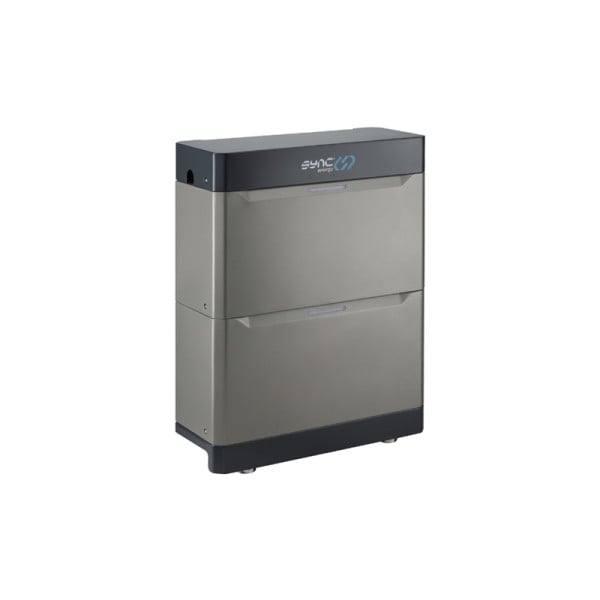
Each house is equipped with a home battery storage unit (like the Tesla Powerwall or other lithium-ion batteries) that stores extra solar energy generated during the day, or even without solar it charges from off-peak electricity, as low as 7 pence per kWh from 11PM to 7AM. The battery provides cheaper electricity to the home, so the lights stay on and the TV runs even though the sun is down. You can charge your electric vehicle with an EV charger during the night from the cheapest source of electricity.
Entire neighborhoods could be connected to local solar farms – fields of larger solar panels – and community battery banks that support the grid when individual homes need more power than their own panels can supply. During sunny days, surplus power from homes and solar farms could charge up the community batteries or even feed into the main grid, helping supply other areas. Your excess energy being sold back to the grid at a profit!

This solar-powered future is technically within reach, but there are many challenges to overcome. Intermittency is the biggest issue – solar panels don’t produce energy at night, and output is lower on cloudy days or in winter. This means reliable energy storage is key if we were to rely on solar as the sole power source. Batteries are one solution, and they are improving rapidly; in fact, adoption of home battery systems is growing quickly as prices fall and technology improves.
Some communities are even linking home batteries to function as a “virtual power plant,” smoothing out supply and demand. Still, on a large scale, we might need other storage methods (like thermal storage, pumped hydro, or even future technologies like hydrogen fuel) to get through longer periods of low sunlight. Another consideration is geography – not every place gets abundant year-round sun. In many regions, sunlight’s variability makes it hard to use as the only energy source without significant infrastructure to store or share power across regions.
The good news is that solar power is modular and scalable. It works on the tiniest scale (a single solar cell on a calculator) all the way up to massive solar farms powering cities. As solar panel efficiencies improve and costs drop, and as batteries and grids get smarter, it’s becoming ever more feasible to get a large share of our electricity from the sun. Some experts have noted that the total solar energy available far exceeds what we use – the challenge is mainly an engineering one of harnessing and storing it cost-effectively.
Many countries are rapidly increasing the percentage of solar in their energy mix. While a 100% solar-powered civilization would require huge investments in storage and distribution, homes with solar panels and batteries are already a reality and growing trend. In the coming decades, it’s likely that solar power (along with other renewables) will play a dominant role in our energy system. Humanity may not be ready to only use solar power just yet, but we are certainly headed toward a future where the sun’s energy supplies a major share – allowing us to boil fewer fossil-fueled “kettles” and instead let the star at the center of our solar system power our lives in a clean and sustainable way.
Sources:
U.S. Energy Information Administration – History of Electricity eia.goveia.gov
American Physical Society – John Walsh’s experiments on electric fish founders.archives.gov
FastCompany/The Conversation – How electric eels inspired Volta’s battery fastcompany.comfastcompany.com
Nuclear Innovation Institute – “Big kettle” analogy for power plants nuclearinnovationinstitute.ca
National Geographic – Solar energy potential and challenge seducation.nationalgeographic.org
MIT News – Sunlight sufficient to meet global needs (with storage) news.mit.edu