
403 Forbidden
ERR_WEB_NGX_403

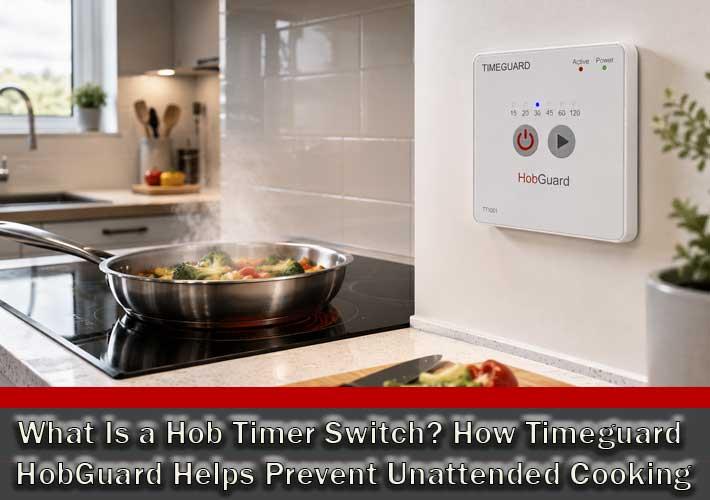
Leaving a hob switched on by accident is one of the most common kitchen safety concerns. It can happen when someone becomes distracted, forgets the hob is in use, or leaves the kitchen before turning the appliance off. In homes, rental properties, student accommodation, supported housing and assisted living environments, this can create a serious fire risk.
According to the latest GOV.UK fire statistics for England, cooking appliances were the largest specified ignition category for accidental dwelling fires, accounting for 44% of these fires in the year ending March 2025. This makes hob safety an important consideration for landlords, housing providers, care providers and families who want to reduce the risk of unattended cooking.
A hob timer switch is designed to help solve this problem by automatically switching off the hob after a selected period of time. The Timeguard HobGuard hob timer switch range provides an extra layer of protection by allowing the hob to operate for a set time before cutting the power automatically.

The main problem HobGuard solves is the risk of a hob being left on unattended. This can happen in almost any household, but the risk is higher in properties where occupants may be elderly, vulnerable, forgetful, easily distracted, or less able to react quickly in an emergency.
HobGuard is especially useful where the aim is to improve kitchen safety without completely removing a person’s independence. Instead of preventing someone from cooking, it allows controlled use of the hob for a selected time period. Once that time has expired, the hob is automatically switched off.
This makes it a practical safety upgrade for:
A hob timer switch is installed into the hob circuit and allows the user to select a timed operating period. Once activated, the hob can be used as normal until the countdown ends. At the end of the selected time, the switch automatically cuts power to the hob.
The Timeguard HobGuard range includes selectable countdown settings of 15, 20, 30, 45, 60, 90 and 120 minutes. This gives flexibility depending on the type of cooking, the user’s needs and the level of control required.
For example, a shorter timer setting may be suitable where closer control is needed, while a longer setting may be used where more cooking time is required. The maximum time and mode can be set using the internal DIP switch, helping to prevent unwanted changes to the safety settings.
HobGuard is worth considering because it deals with a real-world safety issue in a simple and practical way. It does not rely on someone remembering to turn the hob off every time. Instead, it adds a timed safety control to reduce the risk of the hob being left on indefinitely.
For landlords, housing associations and care providers, this can form part of a wider risk-reduction strategy. UK fire safety guidance requires responsible persons to carry out and regularly review fire risk assessments, including identifying people at risk and evaluating, removing or reducing risks where possible. In care settings, CQC guidance also expects premises and equipment to be suitable, properly used, properly maintained and risk assessed where required.
HobGuard should not be described as a legal requirement in itself. However, where a risk assessment identifies unattended cooking as a concern, a hob timer switch can be a sensible control measure and a best-practice safety upgrade.
In assisted living and supported housing, the challenge is often to balance safety with independence. Removing access to cooking facilities may not always be appropriate, but doing nothing can leave a foreseeable risk unmanaged.
A hob timer switch helps create a middle ground. It allows residents to continue using the hob, while adding an automatic shut-off function if the appliance is left on for too long. This can be particularly useful where a person may become distracted, forget that they are cooking, or need additional support to use kitchen appliances safely.
For supported housing providers, care providers and landlords, HobGuard can be considered as part of a wider kitchen safety plan alongside smoke alarms, heat alarms, supervision policies, electrical safety checks and individual risk assessments.
The Timeguard HobGuard range includes two models: the TT1001 and TT1002. The main difference is the current rating and plate format.
| Model | Format | Max Load Current | Resistive Load | Best Suited For |
|---|---|---|---|---|
| TT1001 | 1 gang | 30A | 6.9kW | Standard hob circuits and lower-load hob applications |
| TT1002 | 2 gang | 40A | 9.2kW | Higher-load hob circuits and larger hob applications |
Both models operate on 220–240V AC, include automatic cut-off, use countdown LED indicators and offer the same selectable timer settings. The correct model should be chosen according to the hob circuit and load requirements.


Important: HobGuard should be selected and installed by a competent electrician. The installer should check the hob rating, circuit design, cable size, protective device and back box depth before installation.
HobGuard is suitable for many applications where extra hob safety is needed. Typical examples include:
No, HobGuard is not a specific legal requirement. There is no single UK law that says a HobGuard or hob timer switch must be installed in every assisted living property, care environment or rental home.
However, landlords, care providers and housing providers may have wider responsibilities around fire safety, health and safety, risk assessments and the safe use of premises and equipment. If a risk assessment identifies cooking-related hazards, especially for vulnerable people, then suitable control measures should be considered.
In that context, a hob timer switch such as HobGuard can be a practical way to help reduce the risk of unattended cooking.
If you are looking for a practical way to improve hob safety, reduce the risk of unattended cooking and add automatic shut-off control to a hob circuit, Timeguard HobGuard is a strong option.
View the full range here: Timeguard HobGuard Hob Timer Switches.
A hob timer switch is a control device that allows a hob to operate for a selected period of time before automatically switching it off. It is designed to reduce the risk of a hob being left on unattended.
Timeguard HobGuard allows the user to select a countdown time. Once activated, the hob can be used until the timer expires. At the end of the countdown, HobGuard automatically cuts power to the hob.
HobGuard includes selectable time settings of 15, 20, 30, 45, 60, 90 and 120 minutes.
The TT1001 is a 1 gang 30A model with a 6.9kW resistive load rating. The TT1002 is a 2 gang 40A model with a 9.2kW resistive load rating. The correct model depends on the hob circuit and load requirements.
Yes, HobGuard is well suited to assisted living and supported housing applications where there is a need to reduce the risk of unattended cooking while still allowing the resident to use the hob.
No, HobGuard itself is not a legal requirement. However, it can be used as part of a wider risk-reduction approach where a fire safety or care-related risk assessment identifies unattended cooking as a concern.
Yes, HobGuard is suitable for student accommodation where landlords or accommodation providers want an additional hob safety control to reduce the risk of appliances being left on.
No. HobGuard should not be treated as a replacement for smoke alarms, heat alarms or other fire safety measures. It is an additional control designed to help reduce the risk of a hob being left on unattended.
HobGuard should be installed by a competent electrician. The installer should check the hob load, circuit rating, wiring arrangement and installation requirements before fitting the device.
You can buy Timeguard HobGuard hob timer switches from Expert Electrical here: https://www.expertelectrical.co.uk/timeguard-hobguard-hob-timer-switches.