403 Forbidden
ERR_WEB_NGX_403

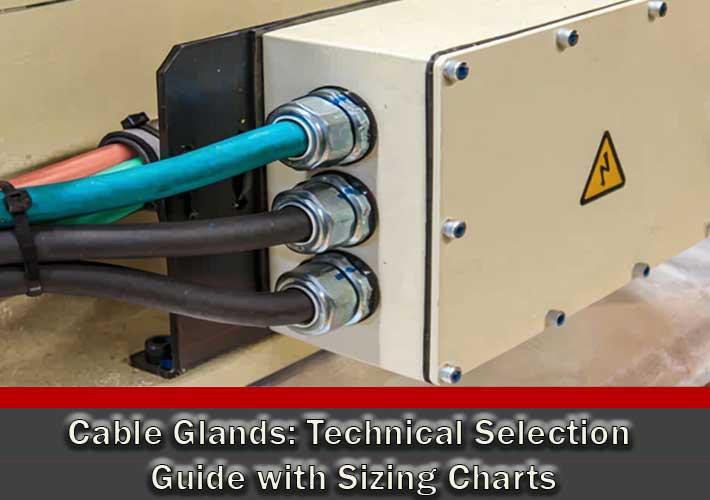
Cable glands are essential components used to secure and seal cables where they enter electrical equipment. They protect your connections from dust and moisture while providing strain relief to prevent cable damage. In this comprehensive guide, we’ll explore the different types of cable glands, their uses with various cable types (SWA, 3183Y flex, YY, CY, SY), thread standards, materials, and installation tips. Whether you’re a DIY enthusiast or an electrical contractor, this guide will help you choose the right gland for a safe and professional installation.
Cable glands (also known as cable connectors or stuffing glands) are mechanical fittings that attach to the end of a cable and the entry point of an enclosure or device. Their primary purposes include:
Different types of cable glands exist to accommodate various cable constructions and usage environments. In general, choosing a gland involves matching it to your cable type, size (diameter), and the environment (indoor, outdoor, hazardous area, etc.). Using the correct gland is critical – if the gland is the wrong size or type, it may not seal properly (leading to water ingress) or might not grip the cable correctly. Next, we’ll look at common gland categories and which electrical cables they are meant for.

Different cables require different gland designs. Here we break down the main types and where each is used, including popular cable types like SWA, YY, CY, SY, and typical flexible cords (e.g. 3183Y):
Steel Wire Armoured (SWA) cables have a layer of steel wires under the outer sheath, providing mechanical protection and a means of earthing. Terminating an SWA cable requires a special gland that can clamp onto the steel wire armor. The two main types are known as BW and CW glands:
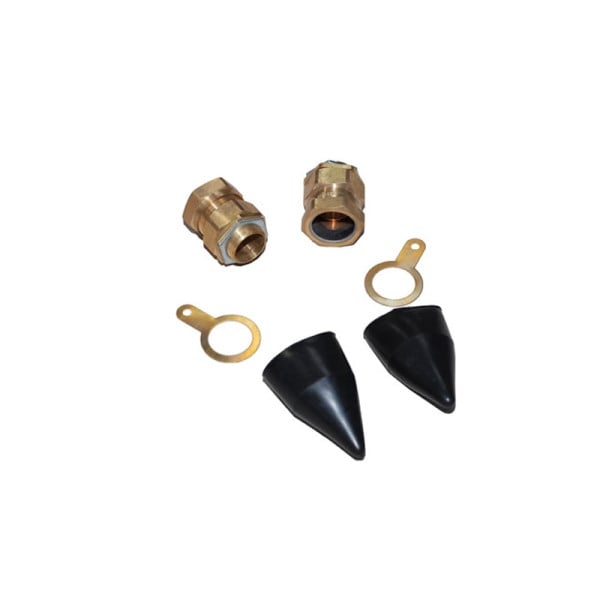
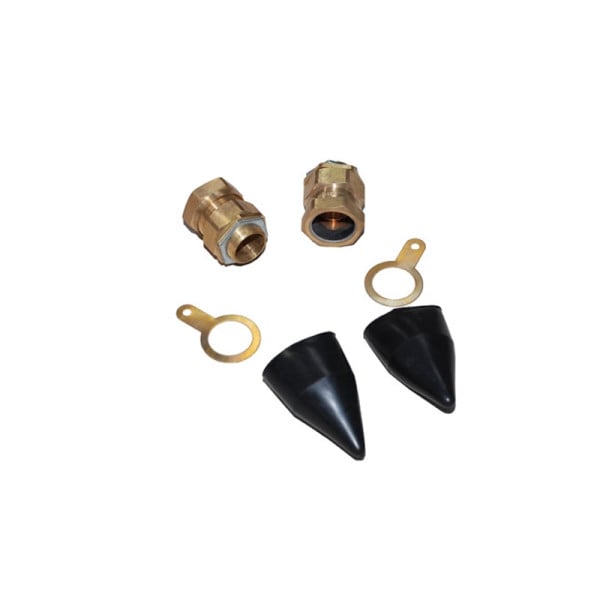
BW Glands (Brass, Indoor): A BW gland is a brass gland for SWA used indoors or in dry environments where a waterproof seal on the outer sheath isn’t required. It consists of a two-part brass body that clamps the armor wires between a cone and ring, ensuring electrical continuity of the armor to the gland body (and thus to earth). BW kits typically include a locknut, an earth tag (often called a “banjo” washer) for attaching an earth lead, and a plastic or PVC shroud.
| Cores | Nominal Cross-Sectional Area of Conductor (mm²) | ||||||||||||||||
|---|---|---|---|---|---|---|---|---|---|---|---|---|---|---|---|---|---|
| 1.5 | 2.5 | 4 | 6 | 10 | 16 | 25 | 35 | 50 | 70 | 95 | 120 | ||||||
| 2 | BW20S | BW20S | BW20S | BW20S | BW20 | BW25 | BW25 | BW32 | BW25 | BW32 | BW32 | BW40 | |||||
| 3 | BW20 | BW32 | BW32 | BW40 | |||||||||||||
| 4 | BW20 | BW25 | BW40 | BW50 | BW50 | ||||||||||||
| 5 | BW25 | BW40 | BW40 | ||||||||||||||
Notes: BW = indoor brass armoured gland (no outer sheath seal). Use CW for outdoor applications. Values reflect the original kit recommendations you supplied; verify against manufacturer charts on final publication.
CW Glands (Brass, Outdoor): A CW gland is a brass gland designed for outdoor use with SWA cables. It includes an additional compression seal that tightens onto the cable’s outer PVC sheath, thus providing a weatherproof seal (typically IP66 or better) on the cable outer jacket. Like the BW, it also clamps the armor for earthing. Use a CW gland whenever the cable gland will be exposed to water or harsh environments, or wherever an IP-rated seal is needed on the cable entry.
| Cores | Nominal Cross-Sectional Area of Conductor (mm²) | ||||||||||||||||
|---|---|---|---|---|---|---|---|---|---|---|---|---|---|---|---|---|---|
| 1.5 | 2.5 | 4 | 6 | 10 | 16 | 25 | 35 | 50 | 70 | 95 | 120 | ||||||
| 2 | CW20S | CW20S | CW20S | CW20S | CW20 | CW25 | CW25 | CW32 | CW25 | CW32 | CW32 | CW40 | |||||
| 3 | CW20 | CW32 | CW32 | CW40 | |||||||||||||
| 4 | CW20 | CW25 | CW40 | CW50 | CW50 | ||||||||||||
| 5 | CW25 | CW40 | CW40 | ||||||||||||||
Notes: CW = outdoor brass armoured gland with outer sheath seal. For dry indoor terminations, see BW gland recommendations. Verify against manufacturer charts prior to publication.
Both BW and CW glands are usually made of nickel-plated brass for corrosion resistance, and both will properly bond the SWA armor. They come in metric thread sizes (e.g. M20, M25, M32, etc.) corresponding to the cable size. Gland size selection depends on the cable’s overall diameter and the armor wire gauge. It’s important to choose the correct size so that the armor grips correctly and the seals fit the sheath – reference charts are used for this purpose (see the tables section placeholders for recommended SWA gland sizes per cable size). Using an undersized or oversized gland can result in a poor seal or ineffective clamping, potentially letting water in or the armor pull out under tension.
Earthing note: With any SWA gland, ensure the armor is properly earthed. Typically, you’ll connect a protective earth conductor to the gland via the earth tag (the thin metal ring with a tail) that sits under the locknut. When the locknut is tightened on a metal enclosure, the earth tag is sandwiched, and its tail can be bolted to the main earth terminal. This way, the steel armor (clamped in the gland) is electrically bonded to earth for safety. Some modern solutions eliminate the separate earth tag – for example, earthing locknuts with an integrated bonding mechanism.
Internal vs External Use: Use BW glands for internal dry installations of SWA cable, and CW glands for external or wet areas, or anywhere you need that outer seal. Both types will physically secure the armor. Many manufacturers offer SWA gland packs that include two glands (for both ends of a cable), two locknuts, two earth tags, and two shrouds as a complete kit.
Control cables often come in variants with braided screens or armor, such as SY and CY cables:
Terminating SY and CY cables poses a challenge: you need to secure the braid and maintain continuity (especially for CY) without compromising the seal on the inner cores. Standard plastic glands only grip the outer sheath and would require you to cut the braid back entirely (losing the shield connection). Thus, specialized glands for braided cables are used.
Traditionally, one option was to use braided cable gland kits often referred by terms like “XT” or “CXT” glands (sold by brands like Doncaster Cables/Unicrimp). These brass glands are somewhat analogous to an SWA gland but designed for the finer wire braids of SY/CY. The braid is typically flared out or formed into a “pigtail” and then clamped between gland components. This method works, but it can be fiddly – it requires carefully splaying the braid and using multiple washers and locknuts to trap it. These gland kits come with necessary parts (usually glands, shrouds, locknuts, etc. similar to SWA kits). They do provide a secure clamp on the braid and an environmental seal on the outer sheath, maintaining continuity for the braid which can then be earthed if needed.
EMC Cable Glands: A more modern solution for braided cables is the use of EMC glands. These are nickel-plated brass glands specifically designed to terminate screened cables by making 360° contact with the braid. They often have an internal cone or spring that presses the braid against the gland body. An EMC gland will simultaneously clamp the cable’s outer sheath and establish electrical contact with the braid, ensuring the shield is properly grounded. Key advantages of good EMC glands include a wide clamping range (to cover various cable diameters), strong strain relief, and reliable environmental sealing. In practice, using an EMC gland is simpler and more effective than wrestling with braid pigtails – you simply insert the stripped cable, and as you tighten the gland, the braid is caught by a special ferrule or spring, making a solid connection. This is highly recommended for CY cables where the braid is serving as an EMI shield; a proper EMC gland will maintain the coverage and grounding of that copper braid around the full circumference.
For YY cables (unscreened/unarmored multicore control cables) or other flexible multi-core cables that have no braid at all, you can treat them like any unarmored cable – a standard nylon compression gland (described later) or a simple brass A2 gland can be used just to grip the outer sheath. The key is that if there’s no armor or braid to terminate, you don’t need the heavy clamping mechanism of an SWA or EMC gland.
Summary: Use braided cable glands or EMC glands for SY and CY cables so that the metal braid isn’t just cut off but is actually clamped and bonded. If you merely use a plain gland and trim away the braid, you lose the benefit of the shield (and in SY’s case, the mechanical protection) – and the loose braid ends could fray. By using the proper gland, you ensure the braid is securely terminated and, for CY, properly earthed (which is important for it to function as a shield).
In recent years, manufacturers have introduced hybrid gland designs that simplify installation and cover a wide range of cable types. Two notable innovations are the STORM® gland range from SWA (Specialised Wiring Accessories) and the ShieldGland® from Wiska. These are designed as better alternatives to the traditional BW/CW or older “XT” type glands, offering easier fitting and high ingress protection.
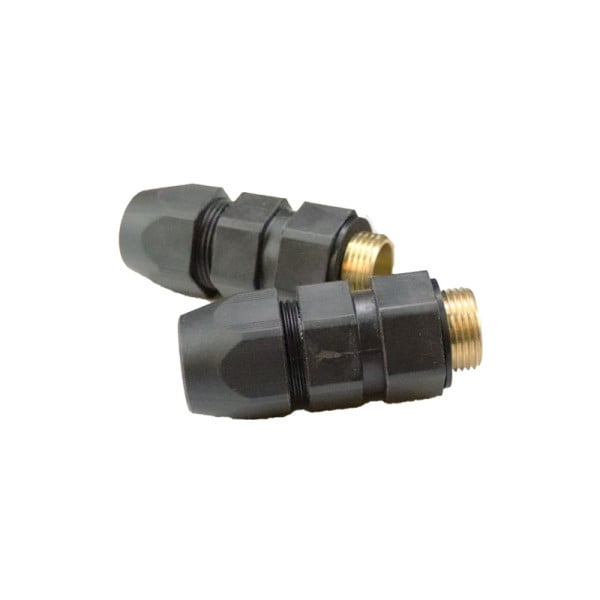
SWA STORM Glands: The STORM range promises a universal approach to terminating armoured and non-armoured, SY & CY braided cables. Storm glands are a fast-fit, IP68-rated solution that provide improved ingress protection and quicker installation compared to conventional armoured glands. Notably, no separate shroud is needed: the gland’s outer body is a tough polyamide that serves as a built-in shroud, covering all the metallic parts. Storm gland kits still include locknuts and earth tags for bonding, but the overall assembly is simpler. These glands are non-corrosive, UV-stabilised, and halogen-free – making them suitable for outdoor use and harsh conditions. They function as a universal gland: for an SWA cable the internal cone will clamp the steel wires, whereas for an SY/CY cable the same gland will clamp the braid. Storm glands are available in common sizes covering the majority of typical cable sizes encountered.
SWA also offers a Tauras STORM version which can incorporate an earthing locknut device for even faster grounding – eliminating the need for the separate earth tag by building the earthing connection into a special locknut. This can further speed up installation because you don’t have to position a banjo washer; the earthing nut bites into the metal enclosure and has a terminal for the earth cable. The Tauras (T-STORM) glands are ideal when you want all the benefits of STORM plus an integrated earthing solution.
| Part No. | Entry Thread | Dia. Minimum (mm) | Dia. Maximum (mm) | Armour Wire Range (mm) |
|---|---|---|---|---|
| STORM20S | M20 × 1.5 | 10.5 | 16.0 | 0.80 – 1.25 |
| STORM20 | M20 × 1.5 | 15.5 | 21.0 | 0.80 – 1.25 |
| STORM25 | M25 × 1.5 | 20.5 | 27.5 | 1.20 – 1.60 |
| STORM32 | M32 × 1.5 | 27.0 | 35.0 | 1.60 – 2.00 |
Pack contents (per kit): 2 glands, 2 earth tags & 2 brass locknuts.
Wiska ShieldGland: The ShieldGland by Wiska is a competing innovation with a similar mission: to replace conventional armoured glands with an easier, IP68 solution. ShieldGland is a plastic/brass hybrid gland – it has a polyamide outer body and a metallic core. Like the Storm, it is suitable for armoured, non-armoured, and SY/CY cables in one design. The polyamide outer body means no separate shroud is required (the plastic body itself is low-smoke, zero-halogen material that covers the metal parts).

Wiska’s design features a unique cone/olive that can be oriented differently depending on whether you’re clamping SWA armor or a braid, giving it a flexible design for multiple cable types. A special gasket is included to broaden the clamping range, ensuring a tight seal over various cable diameters. ShieldGland kits also come with a novel earthing mechanism: instead of a flat earth tag, they supply an “E-spring” – a spring metal ring with an attached earth lead. This wraps around the gland thread inside the enclosure, making a reliable earth bond without needing a screw or nut, and the attached lead goes to the earth bar. This can significantly speed up installation compared to standard earth tags while still providing excellent earthing continuity.

Both Storm and ShieldGland represent a trend in cable glands toward combining plastic and metal to get the best of both: corrosion-proof exteriors and tough metal for armor clamping and grounding. They simplify the process: fewer parts to juggle, no trimming and fiddling with shrouds, and faster earth bonding. If you’re frequently terminating SWA or SY cables, it’s worth considering these newer gland types for efficiency and reliability.
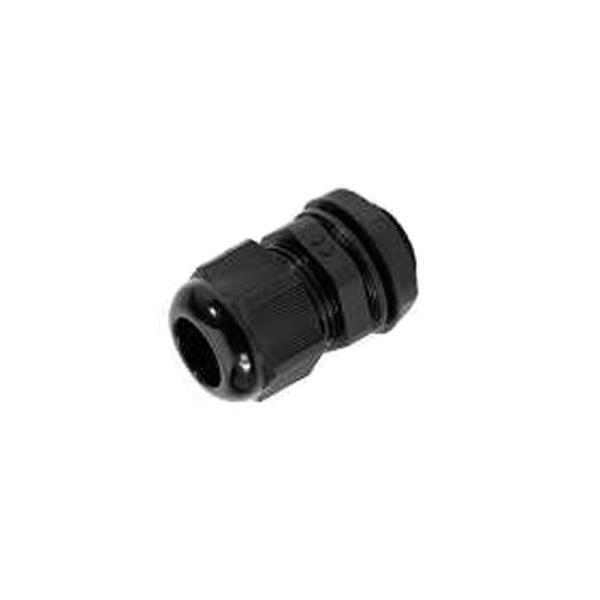
Not all cables have armor or braid. For standard unarmoured cables – such as flexible cords (like a 3-core 1.5 mm² flex code 3183Y) or multi-core YY control cables without braid – a simple nylon compression gland is usually the go-to choice. These glands are often referred to as dome-top glands, stuffing glands, or just plastic cable glands. They are made of tough polyamide (nylon) plastic and have a rubber or neoprene internal seal. When you tighten the gland’s cap, it compresses an inner rubber ring around the cable, creating a tight seal and gripping the cable firmly. This provides a high-integrity entry solution for cables into control panels, junction boxes, consumer units, etc., ensuring dust and water are kept out and that the cable can’t be easily pulled out.
Key features of quality nylon glands include being flame-retardant and typically offering IP68 ingress protection when properly tightened. They also provide strain relief, which is important for flexible cables that might be moved or tugged in use.
These plastic glands come in various sizes, usually denoted by the metric thread (M12, M16, M20, M25, M32, etc.). The size roughly correlates with the clamping range. They also come in multiple colors – commonly black and gray in industrial settings, but white and red versions exist for aesthetic matching or specific applications. The color doesn’t affect function.
Most nylon gland packs include a matching locknut because you often use them in punched or drilled plain holes. If you’re installing into a metal enclosure that has a threaded entry, you might not need the extra locknut; but if it’s just a plain hole, you’ll screw the gland’s body in and use the locknut from inside to tighten it against the wall. The locknut secures the gland in place.
| Thread Size (Metric) | Cable Clamp Range (mm) |
|---|---|
| M12 | 3 – 6.5 |
| M16 | 5 – 10 |
| M20 | 6 – 12 |
| M20 | 10 – 14 |
| M25 | 13 – 18 |
| M32 | 18 – 25 |
Notes: Packs include matching locknut. Ensure the cable’s outer diameter (OD) sits within the stated clamping range for IP68 performance when correctly installed.
When to use plastic glands: Nylon dome-top glands are ideal for any cable that doesn’t require armor bonding. This includes everyday flexes, “YY” PVC control cables, appliance cords, etc. They are widely used in both DIY and professional jobs because they are inexpensive, easy to install, and effective.
Caution: Do not use plain plastic compression glands for terminating armoured (SWA) or braided (SY, CY) cables. They are not designed for that purpose – they won’t make electrical contact with the armor/braid and thus won’t earth it.
When installing electrical consumer units (distribution boards) in the UK, one challenge is bringing in the thick meter tails and earth conductors neatly and safely. Meter tails are typically double-insulated single-core cables (often 25 mm² live conductors and a 16 mm² earth) that connect the main supply to the consumer unit. Modern metal consumer units require that these cables enter through a single opening (to avoid eddy currents in the metal enclosure) and are adequately sealed/protected. This is where special tail glands or kits come into play.
A consumer unit tail gland allows you to pass multiple cables through one gland while maintaining an IP rating and strain relief. For instance, many kits have an insert that allows two 25 mm² and one 16 mm² cable to go through a single gland hole – perfect for two meter tails (live and neutral) plus the main earth. The gland itself is typically large (e.g. M32 or M40 thread) and can be plastic or metal. Kits often come with a thread adapter (reducing washer) so they can fit either a 40 mm or 32 mm knockout hole, and include blanking plugs for unused holes to keep the seal IP-tight.
Benefits:
Cable glands come with different thread types for mounting, and it’s important to match the gland thread to the hole or knock-out of your enclosure (or use an adaptor). The vast majority of modern cable glands use metric threads as standardized by ISO and defined in EN 60423. These are denoted by “M” followed by the nominal diameter (M12, M16, M20, M25, M32, M40, M50, M63, etc.). Metric threads have largely replaced older thread forms in new equipment.
You may also encounter glands or enclosure entries with PG threads (PG7, PG9, PG11, PG13.5, PG16, PG21, PG29, PG36, PG42, PG48). PG is an older German standard. A PG gland won’t fit into a metric threaded hole or vice-versa, so ensure compatibility or use a suitable adaptor.
NPT threads (tapered) are common in America or on some industrial/hazardous area glands. They require tapered threaded entries to seal properly. If you do run into NPT vs metric issues, adaptors are also available, but for general purposes in the UK/EU, metric is the norm, with PG only occasionally.
Summary: Always check what thread type your gland and enclosure use. Using the correct thread ensures the gland tightens securely and maintains the enclosure’s IP rating without cross-threading. Thread reducers and enlargers are available if you need to adapt.
Choose material based on environment and cable type. Indoors in dry, non-corrosive locations, plastic is fine. Outdoors or industrial settings often benefit from brass or stainless. For armored cables, use metallic glands (or hybrid designs with metallic internals) to ensure proper bonding.
By now, you should have a solid understanding of cable glands – from the basic nylon stuffing gland keeping water out of a junction box, to the heavy-duty brass gland bonding an armoured cable, to the clever new hybrids simplifying installations. Selecting the right cable gland comes down to matching type and size to your cable and conditions. A well-chosen and properly installed cable gland protects your wiring and maintains the integrity of your electrical system. If you need help picking the exact size, contact us and we’ll match your cable to the correct gland kit, or explore our full range here: Cable Glands.