403 Forbidden
ERR_WEB_NGX_403

In an era of rising energy costs and environmental awareness, many homeowners are looking for ways to cut their electricity use. One technology gaining attention is voltage optimisation (VO) – a device that promises to reduce power consumption by tweaking the voltage supplied to your home. This report introduces what VO devices are and examines a real-life example: an EnergyAce 100A voltage optimiser installed in a household on the 19th November 2022.

We’ll use actual electricity meter data (from EDF Energy bills, 2020–2024) to see if this device made a dent in the home’s electricity consumption and bills. The goal is to present honest, data-driven findings in an accessible way for homeowners considering such energy-saving investments.
Key context: Prior to installing the VO unit, this home had a very high electricity usage which was mainly because they installed electric heaters in 2020 to replace traditional gas powered radiators. These heaters were installed during a time when electricity was costing 14.55 pence (or £0.15) per kWh. In 2022 energy costs increased sharply to 34 pence (or £0.34) per kWh, which was mainly due to the second Russian invasion of Ukraine and the UK's over reliance on fossil fuels. When the UK government taxes energy companies 78% tax on their profits they should also take some accountability for the heavy burden that this placed on the UK tax payer. We wrote an article about how UK energy prices compare globally.

A voltage optimisation device is essentially a specialised transformer or regulator installed in your electrical system to reduce and stabilise the incoming voltage to an optimal level. In the UK, the mains supply often delivers around 240 volts (and can legally range up to about 253V under national standards (energyace.co.uk), which is higher than what most appliances actually need (the Europe-wide nominal voltage is 230V). This “over-voltage” isn’t harmful in the short term (modern appliances are built to tolerate it), but it can lead to wasted energy and excess heat. A VO unit acts like a control valve for voltage – it “optimises” (lowers) the voltage to a level closer to 220–230V, thereby reducing the energy consumed by devices that don’t require the extra voltage.
Put simply, if your home is being fed more volts than necessary, a VO device will trim that excess. Certain types of electrical loads are voltage-dependent, meaning they draw power proportional to the supply voltage. Examples include resistance heaters, electric towel rails, heated mirrors, and some older or simpler household appliances that don’t have built-in power regulation. By lowering the voltage these devices will use less power (for instance, a heating element at 230V outputs a bit less heat than at 245V, often without noticeable difference in a well-insulated environment).
Additionally, running closer to the design voltage reduces strain on equipment, potentially extending appliance lifespan (less overheating, no “over-voltage” stress). It’s a bit like dimming a bright light slightly — you still get enough illumination to see clearly, but you’re using less energy and generating less heat. Voltage optimisation works the same way: your appliances still work perfectly well, but they’re not being overpowered unnecessarily, which saves energy and reduces wear over time.
VO devices come in various forms. Some have a fixed reduction (say, they always drop 20V from whatever comes in), while others are auto-regulating, adjusting the output to keep it at a target voltage even if the grid supply fluctuates. For a home, a typical unit might offer a few selectable settings (for example, the EnergyAce units can be set to reduce voltage by 10V, 15V, 20V, or 25V during installation.
This image shows the internal VO with coil, terminals and main switch, along with the separate consumer unit situated below.

What do manufacturers claim? The selling point is energy saving without needing any change in user behavior. Unlike, say, remembering to turn off lights or upgrading appliances, a VO device works automatically 24/7. Manufacturers often advertise savings in the range of 5% up to around 15-20% on electricity consumption, depending on how high your supply voltage is and what kind of devices you use. For instance, EnergyAce (the maker of the unit in this case study) highlights that customers can “save up to 20%” on bills and provides a guaranteed minimum 10% reduction in kWh consumption – or they refund the cost of the unit.
This 10% savings guarantee is a crucial number: it means if the product works as intended, you should see roughly a tenth shaved off your electricity usage. In practice the exact savings vary – homes with consistently high incoming voltage and lots of old-style lighting or resistive loads might save well above 10%, whereas homes already at a lower voltage or with mostly modern electronics (which often draw constant power regardless of slight voltage changes) might save less.
In summary, a VO device aims to reduce waste caused by unnecessarily high supply voltage. Think of it as “right-sizing” the voltage to what your appliances truly need, thus using electricity more efficiently. Now, let’s look at the specific device installed in our case study home and the household’s situation.
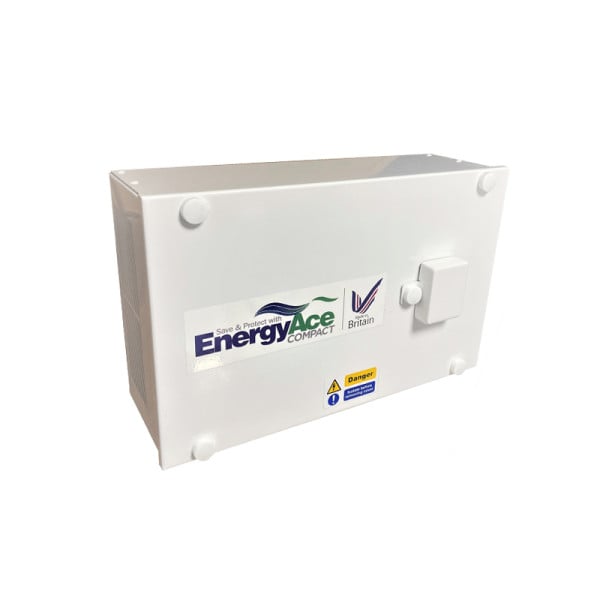
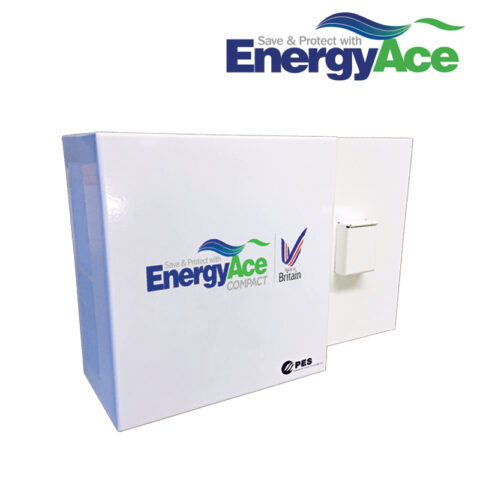
The homeowner in our case study opted for the EnergyAce Compact 100A voltage optimiser as opposed to the 63A version, this model is designed for whole-home use on single-phase supplies up to 100 amps (which covers a typical UK residential supply). The unit was installed on 19th November 2022 by a qualified electrician, wired between the electricity meter and the consumer unit (also known as a fuse box). The installation took around 3 hours and did not require any changes to the home’s internal wiring or appliances (the power was simply turned off, the unit connected in line, and then power restored).
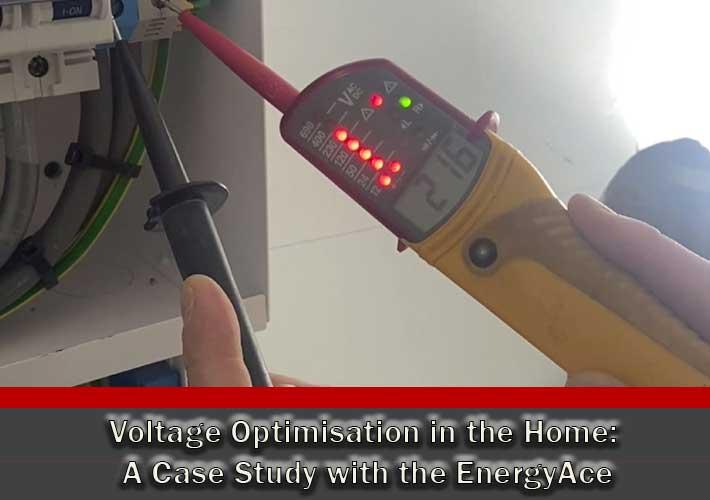
The homeowner chose a voltage reduction setting during the installation – usually this would be based on the measured incoming voltage. For example, if the house often gets ~245V from the grid, setting a –15V tap would target around 230V output. The first setting used in this project was with the –25V tap which brought the supply down from 236V to 211V shown in the voltage test meter below, but 216V is the recommended lowest setting of the device which was ultimately used with the -20V tap.

The homeowner was motivated by extremely high electricity consumption and the promise of lower bills. EDF’s projections showed nearly 18,000 kWh annual usage in 2022, so a 10% cut would equal roughly 1,800 kWh saved per year. At the electricity prices in late 2022 (around 34 pence per kWh under the government’s Energy Price Guarantee cap), that energy would cost about £612 – which is a significant yearly saving. Even at a more “normal” rate of ~15p, 1,800 kWh costs £270, which is still a figure worth saving.
The EnergyAce device came with the 10% savings guarantee and a five-year warranty, which gave the homeowner some confidence that if it didn’t deliver, they could claim a refund. The manufacturer also provided a calculator (the EnergyAce Domestic VO Calculator (shown below)) which, based on the home’s data, projected a monetary saving of £539 per year with the device in place. This figure was based on the 2022 prices of 34 pence per kWh.


Apart from the device installation, no other major changes were made in the home’s electrical usage pattern around that time. The heating system remained the same (the home uses gas for central heating and hot water), and no large new appliances were introduced or removed in late 2022. This makes the electricity data before vs. after November 2022 a fair comparison – any notable change can likely be attributed to the effect of the VO unit (and/or general usage habits influenced by electricity prices). The household did become more conscious of energy usage due to the price spikes, but there were no explicit conservation measures that would dramatically alter consumption; the main intentional change was installing the VO device to passively save energy.
With the stage set, let’s examine the home’s electricity consumption in detail, before and after the voltage optimiser was put into operation.

The electricity usage chart illustrates how energy consumption changed between 2020 and 2024. From 2020 to 2022, the household consistently used a high amount of electricity, peaking at 17,862 kWh in 2022 which was when it was at its most costly rate. Following the installation of the voltage optimisation device in November 2022, a significant reduction is visible — usage dropped to 15,102 kWh in 2023 and decreased further to 14,767 kWh in 2024. This downward trend suggests the device had a measurable impact on reducing wasted electricity, going beyond the manufacturer’s 10% savings guarantee, delivering an actual reduction of 17%.
Based on the data above, yes – the voltage optimisation device appears to have delivered a meaningful reduction in energy consumption for this home. The drop of around 17% in kWh usage aligns well with what one would hope for (and was in fact better than the guaranteed minimum of 10%). While energy costs increased, energy consumption decreased.
In 2023, the household reduced its electricity consumption by approximately 2,760 kWh compared to the previous year, following the installation of the voltage optimisation device. With an average unit rate of 28p per kWh, this reduction equated to a saving of around £772.80 over the year. This highlights the real-world financial benefit of cutting energy waste, particularly during a period of high electricity prices.
It’s worth reflecting on why the savings might be at this level. A reduction in voltage typically does not affect every appliance equally:
Some appliances respond directly to voltage changes — especially simple resistive loads like electric towel rails or older heating elements. These devices naturally draw less power when the voltage is reduced. For example, an electric towel rail rated at 1000W at 240V might only draw around 920W at 230V. The performance remains largely the same for everyday use, but the energy saving adds up over time without any noticeable difference to the user.
Other devices with heating elements (kettles, toasters, electric showers, resistive space heaters) will run slightly cooler at reduced voltage. They’ll draw less power, but also take a bit longer to do their job (e.g. kettle boil time might increase modestly). Depending on usage patterns, some of the energy “saved” might be offset by longer run times. However, in practice many heating devices are thermostatically controlled (e.g. an electric oven or an immersion water heater will just stay on a bit longer to reach the same temperature), so VO doesn’t reduce the total energy those consume to achieve the same result – it just spreads it out. Where savings occur with heating appliances is if people tend to over-use them or use them without needing 100% output; for instance, an old electric heater blasting heat at 240V might be too hot, cycling on/off, whereas at 230V it might maintain a more steady output with less on/off cycling.
Most modern electronics — like TVs, laptops, and phone chargers — use switch-mode power supplies, which regulate power internally. When the input voltage is lowered, these devices draw more current to deliver the same output, so voltage optimisation has little effect on their energy consumption. However, appliances with motors or resistive loads — such as older fridges, washing machines, or electric heaters — can benefit more, as they consume less power at reduced voltage. While voltage optimisation won’t drastically reduce energy use for modern electronics, it can still offer protection from surges and slightly reduce internal heat buildup. If you want surge protection, installing a FuseBox SPD consumer unit will be a better option.
Motors in appliances like fans, pumps, and fridges can respond differently to voltage changes. If lightly loaded, they may use less energy at lower voltage. But if they need to do fixed work — like compressing gas — they might draw more current, reducing or cancelling out savings. Many modern appliances use efficient, electronically controlled motors, so savings vary. Overall, voltage optimisation isn’t mainly about motors — it’s the small gains across multiple appliances that add up.
Given the wide variety of appliances in a typical home, achieving a 17% reduction suggests this property had a meaningful amount of voltage-dependent load beyond just lighting. Interestingly, the homeowner already used all energy efficient LED lighting, which draws consistent power regardless of voltage. This means the savings likely came from other areas — such as the 10x 1,500W electric heaters situated throughout the home totaling 15,000 watts (or 15 kW). It highlights how voltage optimisation can still deliver strong results even in homes with modern, efficient lighting an A+ rated appliances.
Honesty in analysis: We should acknowledge that voltage optimisation has been viewed by some as somewhat negatively in the past – some studies have found minimal savings in certain scenarios, and it’s not a one-size-fits-all miracle. The UK’s Energy Saving Trust in years past suggested modest savings (a few percent) for an average home, which might not justify the cost unless you have a particularly high incoming voltage or specific circumstances. In this case, the house was an outlier in its high consumption, making it a prime candidate and it was a much cheaper alternative to solar. The data from this home provides a real-world validation that in the right conditions, a VO device like EnergyAce can indeed cut energy use by the advertised amount. The key is those “right conditions” – if someone with a low usage or predominantly voltage-independent loads installed it, results could differ.
For this homeowner, the evidence strongly suggests that the EnergyAce 100A voltage optimiser performed exactly as intended. The savings were substantial — around 2,760 to 3,095 kWh less electricity used each year compared to the levels before installation. That’s a significant win financially, especially with electricity prices around 28p per kWh during 2023, translating to hundreds of pounds saved annually. Beyond cost, reducing this amount of energy consumption also lowers the home’s environmental impact — cutting around 3,000 kWh from the grid could reduce carbon emissions by approximately 0.7 to 1 tonne of CO₂ per year, depending on the UK’s energy mix.
Based on your real electricity consumption data from 2023, the EnergyAce Compact 100A voltage optimiser delivered an annual saving of approximately £772.80, reducing your usage by 2,760 kWh. With a total installed cost of £829.99, your actual return on investment was just over 1 year — specifically, 1.07 years. This is notably faster than the originally projected ROI of 1.54 years from the EnergyAce calculator, making the purchase even more cost-effective than expected.
Throughout this article, we’ve referenced data derived from the homeowner’s EDF Energy bills and statements. It’s always good to cross-verify such analysis with the source documents. Key evidence from the bills that underpin our findings includes:
Annual Usage Estimates: The EDF bill dated July 2022 (before the VO device installation) lists an “Annual consumption (based on estimates)” of 16,879 kWh for electricity. This snapshot captures the high usage trend prior to installation. In contrast, the EDF bill dated July 2023 (about 8 months after installation) shows “Annual consumption (based on estimates) 15,188 kWh”, reflecting the new lower usage pattern with the VO device. Here's some screenshots of these two values which clearly demonstrates about a 10% drop in expected annual usage. These are official figures from the supplier, adding credibility to the savings claim.


For this high-consumption household, installing a voltage optimisation device has clearly been a success in reducing electricity use. The data indicates a 17% reduction in the first full year, which goes beyond the 10–15% range typically claimed by manufacturers. In this case, the saving was 2,760 kWh, exceeding the EnergyAce 10% savings guarantee and demonstrating the device is performing as promised — or even better. At an average rate of 28p per kWh, that translates to a saving of £772.80 in 2023 alone. Even if electricity prices were to fall, the homeowner would still save several hundred pounds per year, making the investment worthwhile and increasingly attractive as unit rates rise again in the future.

A few key points for homeowners to consider emerge from this case study:
Voltage optimisation can work, but its impact depends on your situation. If your supply voltage is often at the higher end (240V+ in the UK) and you have many voltage-dependent loads (lighting, heating elements, etc.), you stand to benefit the most. In our example, the conditions were favorable, yielding significant savings. Homes with more efficient appliances or lower voltage to begin with might see smaller percentage drops.
Real data is essential. It’s easy to be swayed by a product’s promises, but verifying the outcome with your own meter readings and bills is crucial. Here, by comparing EDF bills year-over-year, we could confidently conclude the VO unit made a difference. Anyone installing such a device should note their pre-installation usage (perhaps take a yearly total from bills) and then monitor the subsequent year to quantify the effect.
Cost vs benefit: The EnergyAce device had an upfront cost, but in this case the payback time was very short due to the high savings. When considering a VO device, do a rough calculation: e.g., 10% of your annual kWh usage times your unit price = estimated annual £ saved. If that’s only £50, a device costing a few hundred pounds may not be worthwhile. If it’s £300+, the investment starts to look attractive. Also factor in that energy prices can rise – savings in kWh are a hedge against future price hikes too.
Additional perks: Beyond pure kWh reduction, voltage optimisers offer some side benefits: they act as a buffer against power surges and can slightly prolong the life of many appliances (less stress from over-voltage). In the homeowner’s experience, they did not report any downsides – the device operates silently in the background. There was no noticeable change in how any appliances functioned day-to-day (no lights dimming visibly, for instance; the optimisation level was set such that everything still received sufficient voltage). So the comfort and functionality of the home were unaffected by the change – except for the lower numbers on the energy meter.
Transparency with data: We highlighted which evidence (bill screenshots, etc.) can substantiate claims. For anyone reading this and considering a similar installation, ask for data or case studies (like this one!) and ensure you will be able to track your own results. Skepticism is healthy – after all, a device that saves you money with no behaviour change might sound too good to be true. But as we’ve seen, the physics is real and the savings can indeed materialize, especially under the right conditions.
In conclusion, the EnergyAce 100A voltage optimiser proved to be an effective energy-saving addition to this home. It contributed to a noticeable drop in electricity consumption, aligning with the manufacturer’s claims and the homeowner’s hopes. For a homeowner with high energy usage, a VO device is certainly worth investigating as part of an energy-saving toolkit – alongside other measures like efficient appliances, insulation, and smart usage habits. It’s not a magic bullet for everyone, but in scenarios like this case study, it can deliver valuable reductions in both energy consumption and cost. Always weigh the pros and cons for your specific situation, but it’s encouraging to see that technology like this can play a role in reducing our electricity bills and carbon footprint without requiring us to change our lifestyle or comfort.